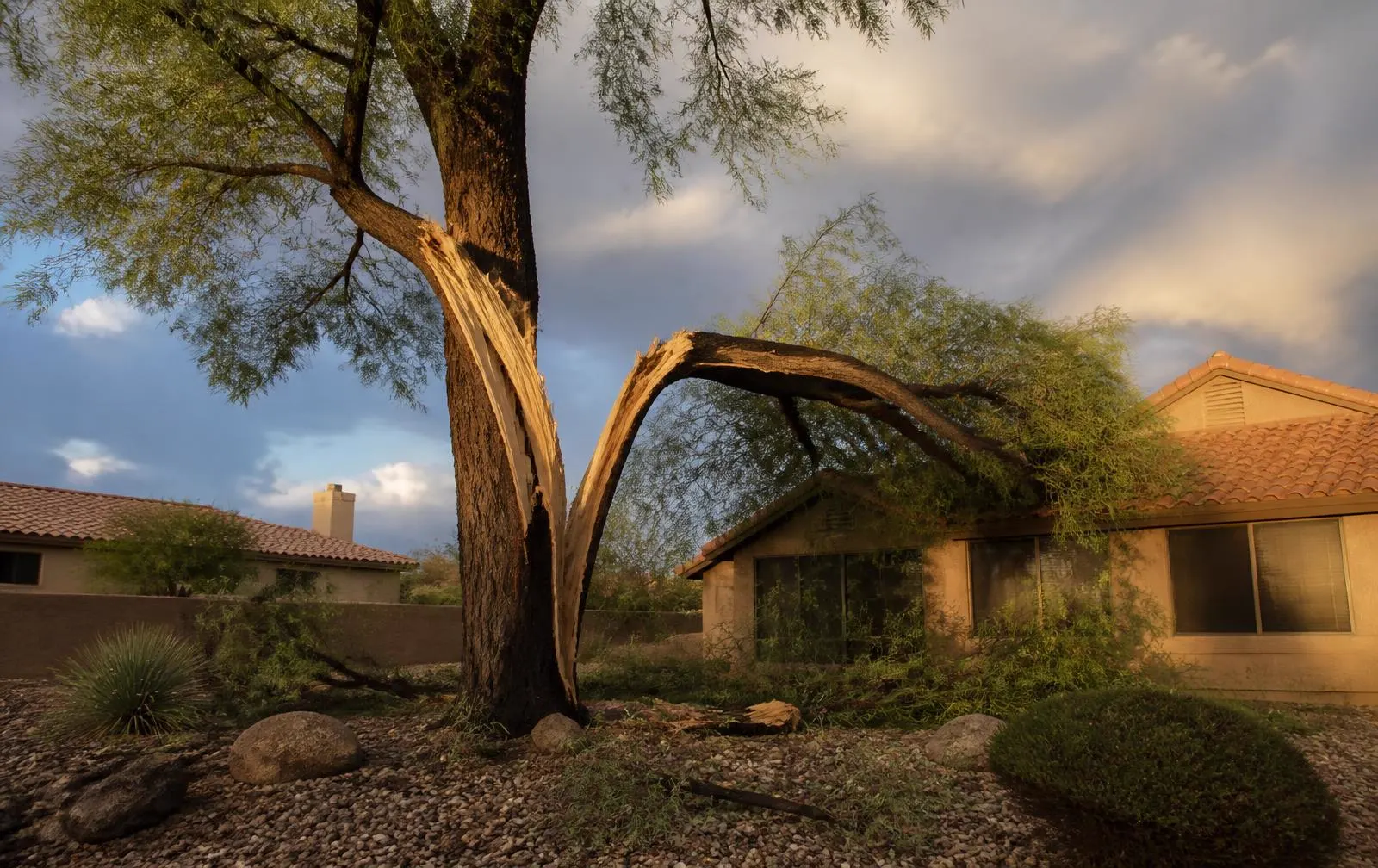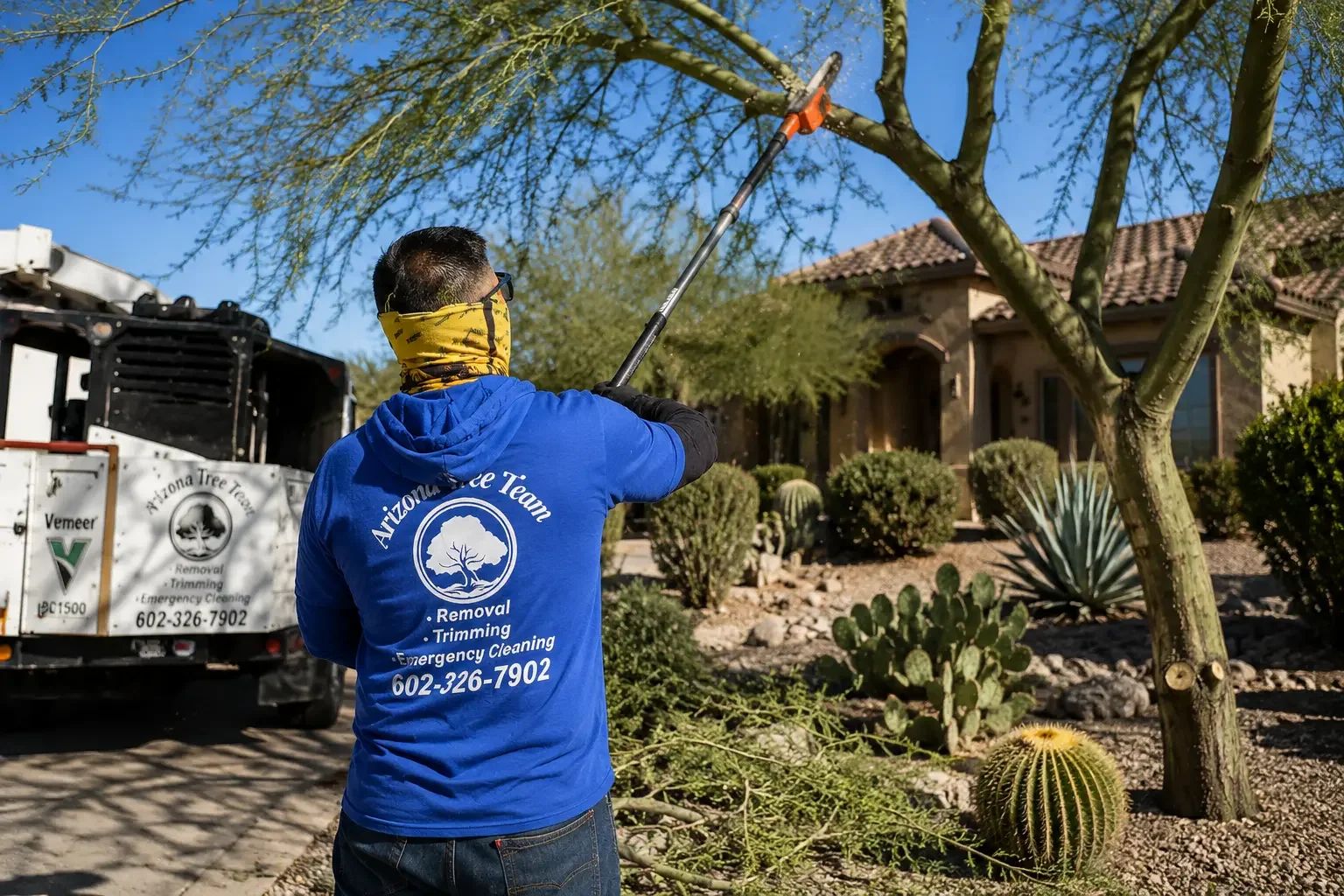
A Phoenix monsoon can change a storm-damaged palo verde in minutes. One strong gust can snap a major limb, split two trunks apart, expose roots, or leave the tree leaning toward your home, driveway, pool, block wall, or a neighbor's property.
If that just happened in your yard, the question is usually simple: can the tree be saved, or does it need to be removed? The answer is not based on how dramatic the damage looks. What matters most is where the tree failed, whether the trunk and roots are still stable, how much healthy canopy remains, and what could be damaged if the tree fails again.
Some storm-damaged palo verdes recover with proper corrective pruning. Others suffer structural damage that makes removal the safer long-term choice. Here is what Phoenix homeowners should know.
Why palo verdes break during Phoenix monsoons
Palo verdes are exceptionally well adapted to Arizona's desert climate, but that does not make them immune to wind damage. Monsoon storms combine strong wind with rain-softened soil, which puts considerable stress on large branches, trunk unions, and root systems.
Landscape conditions matter too. University of Arizona Cooperative Extension notes that desert trees such as palo verdes can develop problems when they receive shallow, frequent irrigation, especially when planted in turf. Those conditions contribute to poor root development and possible toppling.
Previous pruning also plays a role. A tree with poorly distributed weight, long end-heavy limbs, weak branch attachments, decay, or earlier improper cuts is more vulnerable when monsoon winds arrive. Sometimes the storm creates the problem. Other times, the storm simply exposes a structural weakness that was already there.
Quick damage severity guide
This table helps homeowners quickly understand what they are looking at after a storm.
| Damage Type | What It Usually Means | Risk Level |
|---|---|---|
| Small branch break | Minor storm damage | Low |
| Large limb failure | Structural stress or weak attachment | Moderate |
| Split between main trunks | Major structural issue | High |
| Root lifting or soil cracking | Root instability | High |
| Tree leaning after storm | Possible root failure | High |
| Multiple failures | Widespread structural weakness | Very High |
Start with the trunk: where did the palo verde split?
One of the first things we look at after storm damage is where the failure occurred. Losing a secondary branch is very different from having the main trunk split. If a relatively small branch broke away while the primary trunk and major scaffold limbs remain intact, corrective pruning may be enough.
A deep split between two major trunks is far more concerning. Trees do not repair fractured structural wood the way a broken bone reconnects. That does not mean every split requires removal, but a major trunk split deserves a structural assessment, especially when the tree could fall toward a home, vehicle, sidewalk, pool, or other frequently used area.
- Freshly exposed wood between major stems.
- A crack extending down the trunk.
- One trunk pulling away from another.
- Bark separating around a branch union.
- A large stem that moves independently in the wind.
- Decay or cavities around the point where the tree failed.
Check the ground around the tree
Do not look only at the broken branches. Look down. A palo verde can remain standing even though its root system has started moving. After a monsoon, check the ground around the trunk from a safe distance.
A tree that has lost a branch can often be pruned. A tree whose root plate is moving presents a very different problem. Rain softens soil while wind places repeated loads on the canopy. If your palo verde developed a significant new lean after a storm, keep people and vehicles out of the potential fall zone until it can be evaluated.
- Fresh soil cracks near the base.
- Raised soil on one side of the tree.
- Newly exposed roots.
- A root ball that appears to have shifted.
- A new lean that was not there before.
- Movement where the trunk enters the ground.
Root stability versus canopy damage
This comparison helps separate damage that looks bad from damage that is actually dangerous.
| Condition | What You See | What It Means |
|---|---|---|
| Stable roots | No soil movement or lifting | Tree may be saveable |
| Minor canopy loss | Broken branches only | Usually repairable |
| Moderate canopy loss | 25 to 50 percent loss | Needs evaluation |
| Root movement | Cracked or lifted soil | High failure risk |
| Root plate shift | Tree leaning or tilting | Possible removal |
How much healthy canopy is left?
Next, look at what remains. A palo verde that lost one large branch may still retain enough healthy, well-positioned canopy to recover. A tree that lost half of its primary structure is another situation entirely.
The goal is not simply to make the tree look symmetrical again. We are looking at whether the remaining tree has enough sound structure and healthy canopy to keep growing without creating unreasonable risk. University of Arizona summer pruning guidance recommends avoiding removal of more than about a quarter of a palo verde's canopy at one time during routine pruning, because remaining foliage drives photosynthesis. Storm damage does not always leave that choice, since the wind may have already taken a substantial portion of the tree.
Do not top a damaged palo verde to make it even
This is one of the biggest mistakes homeowners make after a storm. Suppose the monsoon strips most of the canopy from one side of the tree. The remaining side now looks uneven, so someone cuts that side back heavily too. Now the tree has suffered storm damage plus excessive pruning.
Palo verdes are unusual because their green bark contributes to photosynthesis. Removing too much canopy also exposes previously shaded branches and trunk tissue to intense Arizona sunlight. Corrective pruning after storm damage should therefore be deliberate: remove broken or unsafe material while preserving as much healthy, well-positioned canopy as reasonably possible.
Look for problems that existed before the storm
A monsoon does not always deserve all the blame. When a palo verde breaks, the failure point often reveals a pre-existing problem.
- Decay or hollow pockets in structural wood.
- Dead wood left in the canopy.
- Weak branch attachments and tight unions.
- Previous topping or improper cuts.
- Excessively long, end-heavy limbs.
- Repeated branch failures on the same tree.
- Root problems or improper planting depth.
- Excessive irrigation close to the trunk.
- Witches' broom or old trunk injuries.
Pre-storm versus storm-only damage
| Scenario | Likely Cause | Recommendation |
|---|---|---|
| One clean branch break | Wind event | Prune and monitor |
| Split at trunk union | Structural weakness | Evaluate immediately |
| Root failure with a lean | Soil and root instability | Likely removal |
| Multiple broken limbs | Pre-existing stress | Full assessment needed |
| Failure at a weak point | Hidden decay or defect | High risk |
Signs your storm-damaged palo verde may be saveable
Every tree is different, but keeping the tree is often reasonable when the following hold true.
- Damage is limited mostly to secondary branches.
- The main trunk remains intact.
- Major branch unions are still structurally sound.
- There is no significant root movement.
- The tree has not developed a major new lean.
- Enough healthy canopy remains to support the tree.
- There is no significant decay at the failure point.
- Corrective pruning is possible without removing excessive canopy.
- The remaining tree does not threaten people or property.
Signs removal may be the safer option
Removal becomes more likely when the tree's primary structure has been seriously compromised.
- A major split through the main trunk.
- Partial uprooting or significant root plate movement.
- A severe new lean after the storm.
- Extensive decay at the point of failure.
- Multiple major structural defects.
- Loss of most of the primary canopy.
- Repeated failures from the same tree.
- Major damage above structures or high-traffic areas.
What Arizona Tree Team looks at after a monsoon
When our arborists evaluate storm damage, the broken branch is only one part of the picture. A useful assessment looks at the entire tree and its surroundings.
| Factor | Why It Matters |
|---|---|
| Failure point | Determines structural integrity |
| Root plate | Indicates stability |
| Remaining canopy | Shows recovery potential |
| Previous pruning | Reveals long-term stress |
| Existing defects | Identifies hidden risk |
| Irrigation history | Affects root strength |
| Target area | Determines consequence of failure |
Save it or remove it? The answer is not always obvious
Some storm-damaged trees are clearly unsafe. Others look terrible right after the storm but still have enough sound structure to recover.
That is why the best question is not whether your palo verde looks damaged. The better question is whether enough sound trunk, root system, and canopy remain for the tree to stay reasonably safe and healthy. If your palo verde split, leaned, uprooted, or lost a major limb during a Phoenix monsoon, Arizona Tree Team can assess the damage and recommend the appropriate next step.