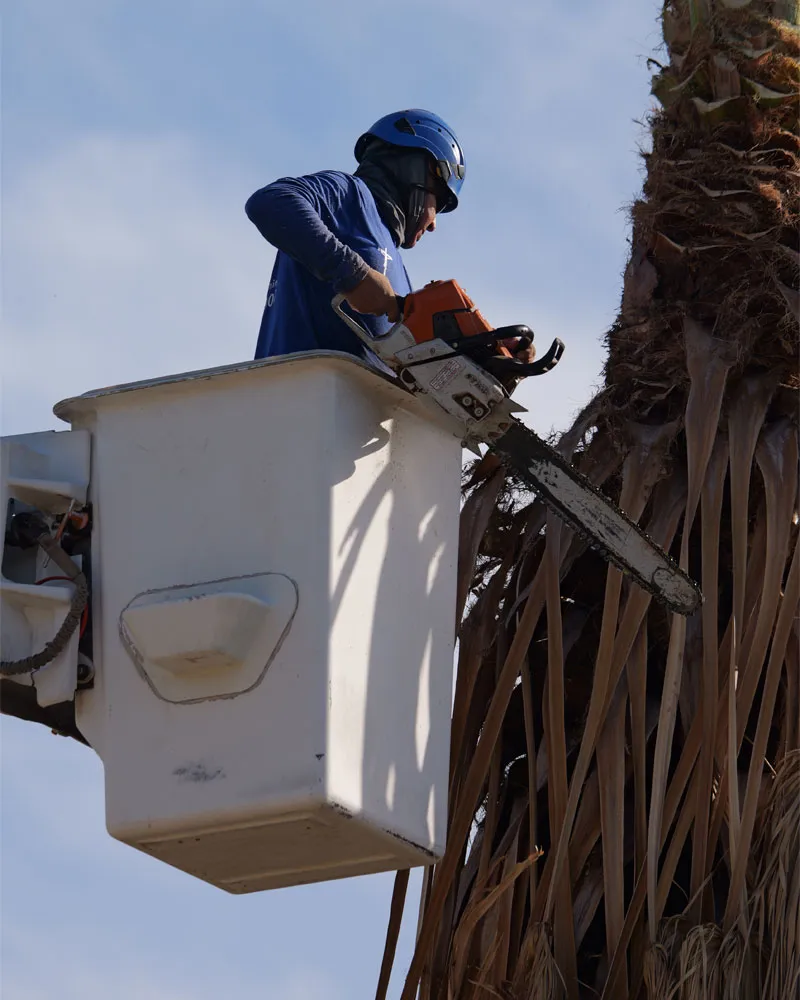
Palm tree trimming in Phoenix for homes and commercial properties is less about forcing every palm onto the same calendar and more about reading the tree. The best routine window often arrives after flower or fruit stalks have emerged, when dead fronds and those stalks can be handled during one visit. The correct amount to remove depends on the species, crown condition, site, and reason for pruning.
That distinction matters because palms are not ordinary branching trees. Most have one growing point at the top, and their trunks do not close wounds the way many woody trees do. An aggressive cut, climbing-spike wound, or contaminated tool can create damage that remains for the life of the palm.
Quick answer: the best time to trim palms in Phoenix
- Plan routine annual pruning in late spring or summer after flower or fruit stalks appear, so dead fronds and stalks come off together.
- Remove freeze-damaged fronds only after the risk of additional cold injury has passed.
- Address broken, hanging, or otherwise hazardous material whenever safety requires it, regardless of the month.
- Do not let a seasonal appointment become permission to remove healthy green canopy.
Why the calendar is only the starting point
The University of Arizona notes that routine annual palm pruning is often scheduled in summer after flower stalks emerge. That timing can reduce repeat work, because the crew removes dead lower fronds and unwanted flower or fruit stalks in the same visit. However, a palm that has not produced stalks, has cold injury, or shows possible disease may need a different plan.
A good recommendation begins with three questions: What species is it? What material is actually dead or hazardous? What is the objective — debris control, fruit removal, clearance, or health? If the answer is merely “make it look cleaner,” the proposed pruning is probably more aggressive than the palm needs.
Phoenix palm trimming calendar
| Timing or trigger | Appropriate work | Key caution |
|---|---|---|
| Late spring to summer, after stalks emerge | Routine removal of dead lower fronds and unwanted flower or fruit stalks | Preserve the full green crown; timing does not justify over-pruning. |
| After winter cold risk passes | Evaluate and remove truly dead freeze-damaged fronds | Damaged tissue is hard to judge too early. |
| After wind or storm damage | Remove broken or hanging material once the area is safe | Inspect the crown and trunk before assuming cleanup is cosmetic. |
| Any season when a hazard is present | Create an exclusion area and arrange qualified help | Never work around electrical lines or beneath unstable material. |
What to remove and what to leave
| Palm material | Typical decision | Why |
|---|---|---|
| Completely brown lower frond | Remove when it creates a debris, access, or appearance concern | It no longer contributes meaningful photosynthesis. |
| Green living frond | Leave it | Green tissue produces and stores energy; removal weakens the palm. |
| Frond above the horizontal plane | Do not remove during routine pruning | Arizona guidance says not to prune living leaves above the 9-and-3 positions. |
| Flower or fruit stalk | Remove after emergence when fruit drop is unwanted | One visit can address stalks and dead fronds together. |
| Old leaf base attached to trunk | Do not force, peel, or aggressively skin | Forced removal wounds permanent trunk tissue. |
| Discolored frond with green tissue | Diagnose before cutting | Yellowing may reflect a nutrient problem the palm is managing. |
Six decisions before anyone makes a cut
1. Identify the palm and the goal. Mexican and California fan palms, date palms, queen palms, and multi-trunk palms do not present the same crown, fruit, access, or disease concerns. Name the species and define the reason for every proposed cut.
2. Separate dead tissue from living canopy. Brown, dead lower fronds are different from green or partly green leaves. The University of Arizona strongly discourages removing living leaves because it reduces energy production and storage.
3. Protect the 9-and-3 crown line. Imagine a clock across the crown. Routine pruning should not remove living fronds attached above the horizontal 9-and-3 positions. A narrow hurricane cut is not better maintenance.
4. Limit the amount removed. Arizona guidance recommends removing no more than 25 percent of the living canopy in a season, and avoiding more than one pruning per season. In normal maintenance, simply preserve healthy green fronds.
5. Protect the trunk and growing point. Palms have a single terminal growing point, and damage there can kill the plant. Spikes and aggressive skinning create permanent wounds because the trunk cannot close them.
6. Use clean tools and safe access. Pruning tools can transmit palm diseases between trees. Tall palms, heavy fruit stalks, and lift work belong with trained crews using an exclusion zone.
Why over-trimming hurts Phoenix palms
Over-pruning may create a tidy silhouette for a few weeks, but it removes the leaf area the palm uses to support growth and repair. Consequently, repeated green-frond removal leaves the palm with less energy during heat, drought, or nutrient stress.
- A thin, feather-duster crown usually means too many green fronds were removed.
- Yellow fronds should not be cut automatically; deficiency symptoms appear in older leaves first.
- Peeling stubborn leaf bases injures the trunk rather than improving palm health.
- Spikes, nails, and tool wounds remain visible and can create infection pathways.
- Dirty saws move pathogens from one palm to the next.
Common Phoenix palms and maintenance cues
| Palm group | What commonly drives service | What to protect |
|---|---|---|
| Mexican or California fan palm | Persistent dead skirt, tall access, flower or fruit stalks | Full green crown and undamaged trunk tissue |
| Date or Canary Island date palm | Heavy fruiting structures, large armed fronds, specialized access | Green leaves, clean tools, and the terminal bud |
| Queen palm | Dead lower leaves or nutrient-related discoloration | Partly green leaves until the cause is understood |
| Mediterranean fan or pygmy date palm | Multiple stems, low clearance, dead leaves, or fruit | Healthy stems and enough living foliage per crown |
Palms near power lines need utility coordination
Do not prune a palm that is touching or close to overhead electrical lines. APS states that only an APS-approved contractor may trim trees near its power lines, and asks customers to report vegetation concerns for assessment. SRP provides similar direction for trees near its system. Therefore, contact the serving utility rather than hiring routine landscaping work inside an electrical hazard zone.
What a professional estimate should explain
Palm-trimming prices vary too much for a responsible quote based only on a photo or a height guess. A property-specific estimate should identify:
- Palm species, approximate height, number of palms, and current crown condition.
- Whether the scope includes dead fronds, stalks, loose material, and haul-away.
- Access for a bucket lift, plus gates, slopes, pools, roofs, and adjacent property.
- Utility conflicts, falling-object controls, cleanup expectations, and any return visit.
- Proof of applicable insurance and the named person responsible for the pruning plan.
When DIY palm cleanup stops being reasonable
A homeowner can often collect fallen debris or use hand pruners on a small, ground-level palm after checking for sharp petioles. Stop when the work requires a ladder, overhead cutting, a chainsaw, a lift, electrical clearance, or handling a heavy suspended frond or fruit stalk. Falling palm material is far heavier than it looks.