If you have called around for tree removal in Phoenix, you have probably noticed that quotes for the same tree can vary widely. That is not because tree removal pricing is arbitrary. It is because removing a tree is a rigging and logistics job, and every property changes the plan.
Tree removal cost in Phoenix is driven by how big the tree is, what species it is, how a crew can physically reach it, what sits underneath it, and how much material has to leave your property when the work is done. A mesquite standing alone in an open gravel yard and a eucalyptus wedged between a pool deck and a block wall are two completely different jobs, even if the trunks measure the same.
This guide walks through what actually moves the number on a tree removal estimate in Phoenix, Scottsdale, Mesa, Chandler, Gilbert and the rest of the Valley, so you can read a quote, compare it fairly, and know when the cheapest bid is the expensive one.
What you are actually paying for on a tree removal
A tree removal quote is not a price per foot. It is an estimate of crew hours, equipment, risk, and disposal. Understanding those four pieces explains almost every difference you will see between bids.
Crew hours cover the climbing or bucket work, the cutting, the rigging of each piece down, and the cleanup. Equipment covers saws, ropes, chippers, dump trucks, and sometimes a crane or lift. Risk covers what the crew has to protect: your roof, pool, patio, block wall, irrigation, utility lines, and the neighbor's property. Disposal covers hauling wood and debris off site, which is a real cost on every job.
- Crew size and the hours the removal realistically takes.
- Climbing versus bucket truck, lift, or crane access.
- Rigging complexity when pieces cannot simply be dropped.
- Protection of structures, hardscape, pools, and landscaping.
- Hauling and disposal of wood, brush, and debris.
- Licensing, insurance, and trained crew on the property.
Size and species: why a mesquite and a palm price differently
Height and trunk diameter are the starting point, but species matters just as much in the desert. Canopy spread, wood density, how the tree is structured, and how the debris breaks down all change the time on site.
Common Phoenix trees behave very differently on a removal. A multi-trunk mesquite has a wide, heavy, spreading canopy that has to come apart in controlled pieces. A palo verde has lighter wood but often leans over something you care about. Palms are tall, heavy, and the material does not chip like hardwood. Eucalyptus and pine get very large and very heavy for their size. Ficus produces enormous volumes of green waste for its height.
This is why the honest answer to "how much does it cost to remove a tree" is always a site-specific one. The species tells an estimator how the tree will come down; the property tells them how long that will take.
- Overall height and the reach needed to work the canopy.
- Trunk diameter at the base and the number of main trunks.
- Canopy spread and how far limbs extend over structures.
- Wood density and total weight of material to be moved.
- Whether the debris chips cleanly or has to be hauled whole.
- Dead, decayed, or storm-damaged wood that cannot be climbed safely.
The main cost drivers, side by side
This table summarizes what raises or lowers a tree removal estimate in the Phoenix Valley.
| Cost Driver | Lower Cost When | Higher Cost When |
|---|---|---|
| Tree size | Small to mid-size, easy to reach canopy | Tall, wide, or multi-trunk with heavy limbs |
| Species | Lighter desert wood, clean chipping debris | Dense hardwood, palms, or high debris volume |
| Access | Open yard, gate and street access for equipment | Backyard only, narrow side gate, no equipment path |
| Drop zone | Open gravel or dirt below the tree | Pool, patio, roof, wall, or shared property line below |
| Tree condition | Sound, stable wood safe to climb | Decay, storm damage, or leaning toward a structure |
| Cleanup scope | Homeowner keeps wood, minimal hauling | Full haul-away, stump grinding, and site cleanup |
| Timing | Scheduled work planned in advance | Emergency response after a monsoon or hazard |
Access is usually the biggest variable
Homeowners often assume the tree itself sets the price. In practice, access to the tree is frequently the single largest factor in the cost to cut down a tree in Phoenix.
If a crew can back a truck and chipper up to the tree, material goes straight from the saw into the chipper and the job moves quickly. If the tree is in a back yard behind a narrow side gate, every branch and every log has to be carried by hand across the property. The same tree can take a fraction of the time in a front yard that it takes behind a wall.
Newer Valley subdivisions in Gilbert and Chandler often have tight side yards and block-wall corridors. Older Phoenix and Mesa neighborhoods can have alley access that makes a difficult tree simple. This is one of the reasons an accurate estimate requires someone standing on the property.
- Width of the side gate and the path to the tree.
- Whether a chipper and dump truck can get close.
- Distance debris must be carried by hand.
- Overhead obstructions between the tree and the street.
- Soft turf, pavers, or irrigation the crew must avoid driving over.
- Whether a lift or crane is needed because climbing is unsafe.
What is under the tree: pools, roofs, walls, and power lines
A tree with nothing beneath it can often be cut in large pieces and dropped. A tree over a pool, patio cover, roofline, or shared block wall has to be dismantled piece by piece and lowered on ropes. That rigging work is slower, requires more crew, and carries more risk, and it is reflected in the estimate.
Proximity to utility lines changes the job as well. Work near energized conductors is restricted and may require coordination with the utility before anything is cut. If a quote you receive ignores lines that are clearly in the work area, that is a sign the estimator has not planned the job carefully.
The practical takeaway for homeowners: a higher quote is not automatically padding. Frequently it is the only bid that accounts for what the crew has to protect.
Removal only, or removal with grinding and haul-away?
Scope is where quotes drift apart most often. Two estimates can be hundreds of dollars apart simply because one includes the stump and the debris and the other does not.
| Scope | What It Includes | What Is Left Behind |
|---|---|---|
| Removal only | Tree taken down and cut into manageable pieces | Stump, wood, and debris on site |
| Removal + haul-away | Tree down, all wood and brush removed | Stump remains at grade |
| Removal + stump grinding | Tree down, stump ground below grade | Grindings, unless cleanup is included |
| Full service | Removal, grinding, haul-away, and site cleanup | Clean, usable ground |
Is the stump included? Usually not by default
Stump grinding is a separate operation with separate equipment, so it is typically priced as its own line item rather than folded into the removal. Stump size, root flare width, access for the grinder, and how deep you want the stump taken all affect that number.
Leaving a stump is not just cosmetic in the desert. A stump and its root system continue to decay in place, and decaying wood in the ground is a known draw for pests, which is why we cover the issue in detail on our stump grinding service page. If you plan to replant, re-landscape, or extend hardscape in that spot, grinding is usually worth including in the same visit while the crew and equipment are already there.
- Stump diameter measured at the widest root flare.
- How deep below grade you need the stump taken.
- Whether the grinder can physically reach the stump.
- Rock, concrete, or utilities near the root zone.
- Whether grindings are hauled off or left to backfill the hole.
- Surface roots that also need to be ground out.
Emergency storm removal versus scheduled removal
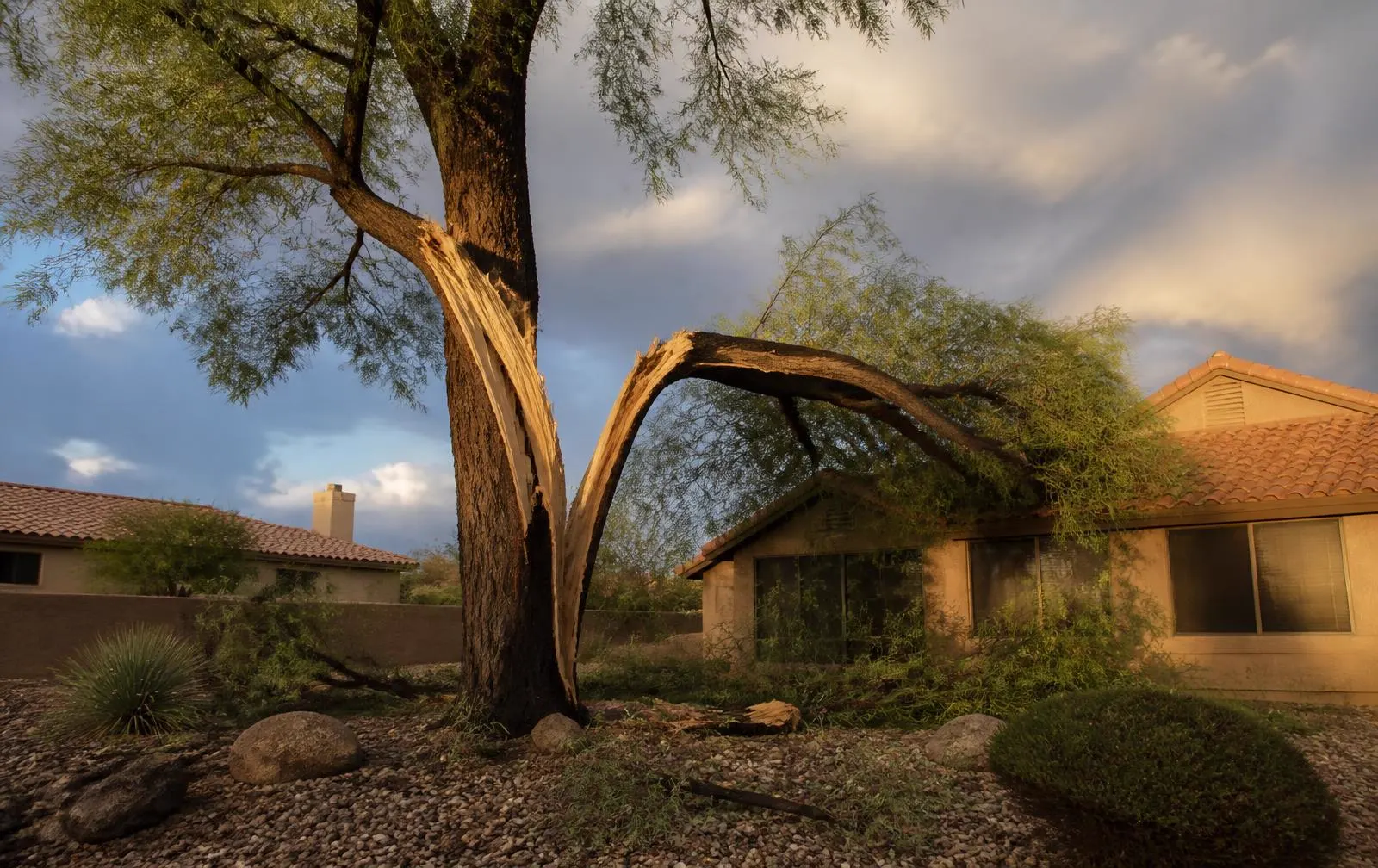
Monsoon season changes the math. An emergency removal means a crew mobilizing quickly, often outside normal scheduling, to deal with a tree that is already on a roof, a vehicle, a wall, or blocking access. That work involves more risk assessment, more careful rigging on compromised wood, and no ability to plan the day around it.
Scheduled removal is almost always the more economical path. If a tree already worries you before the storms arrive, addressing it in the planning window is cheaper than addressing it as an emergency after it fails. Our emergency tree service page explains what to do when a tree comes down unexpectedly, and our monsoon prep guidance covers the work that prevents that call in the first place.
When pruning is the cheaper correct answer
Not every problem tree needs to come out. Homeowners often call for a removal quote when the actual issue is an overextended limb, a canopy that has grown into the roofline, or a tree that has never been structurally pruned.
Proper pruning is typically less expensive than removal, keeps the shade you already have, and in the Phoenix heat that shade has real value on the west and south sides of a house. A reputable company will tell you when pruning solves the problem and will explain plainly why removal is the right call when it is. If you are weighing the two on a specific tree, our guide on when to prune versus remove a mesquite walks through the decision.
Removal becomes the better answer when the tree is structurally unsound, significantly decayed, dead, growing into a foundation or pool shell, or positioned where another failure would hit something that matters.
What a written tree removal estimate should spell out
The most useful thing you can do when comparing tree removal prices in Phoenix is to insist that every bid describes the same scope in writing. Once the scope matches, the numbers become comparable.
- Exactly which trees, by location on the property.
- Whether the stump is included and to what depth.
- Whether wood, brush, and grindings are hauled away.
- Protection measures for pool, hardscape, turf, and irrigation.
- Proof of license and liability and workers' compensation insurance.
- How access will be handled and where equipment will be staged.
- Cleanup standard when the crew leaves the property.
Red flags when a quote looks unusually low
A low bid can be a fair bid from an efficient crew. It can also mean the company is not carrying insurance, is not planning to haul the debris, or is not equipped for the rigging the job actually requires. In Arizona, tree work is done with saws and ropes above your house; an uninsured crew on your property is a risk you absorb.
Door-to-door offers after a monsoon deserve particular caution. Storm chasing is common across the Valley, and the low number quoted at the curb frequently does not survive contact with the job.
- No written estimate, or a verbal number only.
- No proof of liability or workers' compensation insurance.
- Pressure to pay the full amount in cash up front.
- Vague language about cleanup, hauling, or the stump.
- A crew that cannot explain how the tree will come down.
- Unsolicited door knocking immediately after a storm.
How estimates work at Arizona Tree Team
We give free estimates, and we give them on site. An estimator looks at the tree, the access, the drop zone, and what is around it, then puts the scope in writing so you know exactly what is and is not included before any work starts.
We are licensed and insured, we work throughout Phoenix, Scottsdale, Mesa, Chandler, Gilbert and the surrounding Valley communities, and we bring more than 30 years of hands-on experience to the assessment. If pruning is the better answer for your tree, we will tell you that instead of quoting a removal.
The short version on tree removal cost in Phoenix
There is no honest flat rate for tree removal, and any number quoted before someone has seen the tree is a guess. Size and species set the baseline. Access, the drop zone, and the tree's condition set the real cost. Stump grinding and haul-away set the final scope.
If you want an accurate number for your property, the fastest route is a free on-site estimate. Call us at (602) 326-7902 or request an estimate and we will look at the tree, explain the options in plain language, and put the scope in writing.