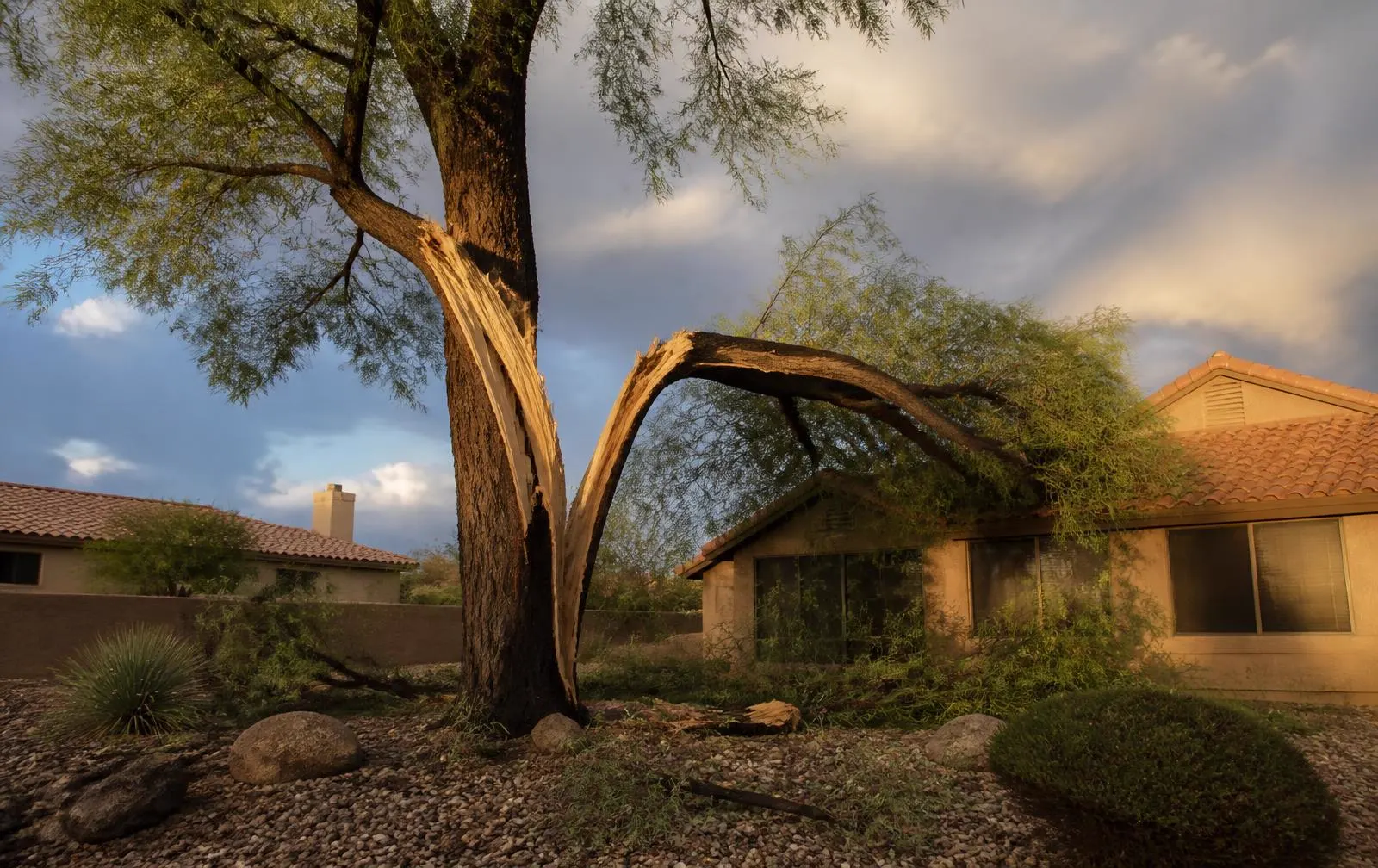
A Phoenix monsoon can damage a storm-damaged tree in minutes. Strong outflow winds break limbs, rain softens the soil around roots, and falling branches can block a driveway or strike a roof. Other problems are less obvious: a new lean, lifted soil, a split branch union, or a cracked trunk may remain long after the loose debris is gone.
Not every storm-damaged tree needs removal, but every suspected hazard deserves a careful response. This guide explains what to check from a safe distance, when to involve the utility or emergency services, and how a tree-care professional decides whether pruning, monitoring, stabilization, or removal is appropriate.
Why Phoenix monsoons expose hidden tree problems
Monsoon damage is rarely caused by wind alone. Strong outflow winds apply force to the canopy while rain changes conditions around the roots. A tree that looked normal beforehand may already have had a weak branch union, decay, damaged roots, poor balance, or an old pruning wound. The storm simply becomes the event that reveals the weakness.
Species and size provide context, but they do not determine risk by themselves. A professional also considers the specific defect, soil movement, canopy distribution, recent construction or trenching, irrigation patterns, and what the tree could strike. Two similar trees on neighboring properties can require completely different responses.
- Heavy growth concentrated on one side of the canopy.
- Co-dominant stems with a narrow, splitting union.
- Roots cut by construction, hardscape, trenching, or utility work.
- Decay, cavities, deadwood, or previous branch failures.
- Repeated ponding, erosion, or sudden soil movement near the trunk.
Safety comes before tree cleanup
Wait until the storm and lightning threat have passed before inspecting the yard. The National Weather Service warns that monsoon thunderstorms can produce damaging winds, flying debris, falling trees, and downed power lines. If a tree or branch is touching a wire, do not approach it or try to determine whether the line is energized.
APS instructs the public to stay at least 100 feet from a downed power line and call 911. Keep people and pets out of the area until the utility or emergency responders declare it safe.
- Inspect from the ground — never climb a damaged tree.
- Move vehicles and outdoor furniture away when that can be done safely.
- Photograph the tree, roots, fallen limbs, structures, and access points.
- Do not cut a bent or suspended limb that may move suddenly when released.
Phoenix storm-damage triage table
| What you see | Immediate action | Who to contact |
|---|---|---|
| Tree or branch touching a wire | Stay 100 feet away; keep others back. | Call 911, then the serving utility. |
| Tree on a roof, vehicle, or occupied area | Leave the threatened area; do not move the tree. | Emergency responders if anyone is at risk, then insurer and tree service. |
| New lean, lifted soil, or exposed roots | Create an exclusion zone around the fall direction. | Qualified tree-care professional for urgent assessment. |
| Large hanging or split limb | Keep the area below and around it clear. | Professional tree service with suitable access and rigging equipment. |
| Small fallen twigs with a stable tree | Document and clean only reachable ground debris. | Routine inspection if no structural defect is visible. |
Seven warning signs a storm-damaged tree may be unsafe
Look from several angles without standing beneath damaged branches. These signs do not diagnose the tree by themselves, but they justify a professional evaluation.
The tree developed a new lean.
A long-standing lean may be part of normal growth. A lean that appeared after wind or rain is different, especially when the soil is cracked, mounded, or lifting on the opposite side. That combination may indicate movement in the root plate.
Roots are exposed, broken, or pulling from the soil.
Roots anchor the tree. Fresh gaps around the base, torn roots, heaving soil, or a partly uprooted trunk can mean stability has changed. Keep clear of the likely fall path and arrange an urgent assessment.
The trunk or a major union is split.
A crack through the trunk or through the junction of two large stems can compromise load-bearing wood. Do not wrap, bolt, or pull the split together yourself; the tree must be evaluated in relation to its size and nearby targets.
Large limbs are broken but still attached.
Suspended limbs can shift without warning. A branch caught in the canopy may be under tension, and cutting it can release that energy unpredictably. Damage above a roof, driveway, sidewalk, or play area needs prompt professional attention.
A large portion of the canopy is gone.
The amount and location of canopy loss both matter. A tree may recover from limited damage when its trunk, roots, leader, and main structure remain sound. Extensive loss or an unbalanced crown can change both health and stability.
Bark is torn or wood is freshly exposed.
Stripped bark, deep trunk wounds, and torn branch attachments deserve inspection. Avoid painting wounds or making flush cuts. Correct pruning preserves the branch collar and limits additional injury.
The tree now threatens a target.
Risk depends on what the tree or branch could strike. A defect becomes far more urgent when it sits over a house, vehicle, power line, gate, sidewalk, pool area, or the only entrance to the property.
Can the tree be saved, or does it need removal?
The decision should consider the whole tree, not one dramatic-looking branch. The International Society of Arboriculture notes that risk may sometimes be reduced by pruning, moving a possible target, adding support, or providing routine care. Trees with unacceptable risk may require removal.
| Condition | Possible response | Important qualifier |
|---|---|---|
| Small broken branches; trunk and roots stable | Corrective pruning and monitoring | Cuts must preserve healthy attachment tissue. |
| One major limb failed; remaining structure appears sound | Professional pruning and risk assessment | A large wound or imbalance can change the recommendation. |
| New lean, root-plate movement, or trunk split | Urgent assessment; removal may be necessary | Do not occupy the potential fall zone. |
| Tree has fallen on a structure or blocks critical access | Controlled removal and site cleanup | Utility, emergency, and insurance coordination may come first. |
What not to do after monsoon tree damage
- Do not top the tree — cutting major limbs back to stubs creates weak regrowth and added stress.
- Do not use a ladder or overhead chainsaw around broken, suspended, or power-line-adjacent limbs.
- Do not remove healthy canopy simply to make the tree look balanced after a failure.
- Do not pull a fallen tree off a roof or vehicle without a controlled removal plan.
- Do not accept a removal recommendation that skips an explanation of the defect, target, and alternatives.
What a professional tree inspection should cover
A useful inspection connects visible defects to the likelihood and consequences of failure. The scope should include:
- Root-zone movement, soil heaving, exposed roots, and irrigation or drainage conditions.
- Trunk cracks, cavities, decay indicators, bark damage, and major branch unions.
- Broken, hanging, dead, or heavily extended limbs and the remaining canopy balance.
- Targets such as structures, vehicles, walkways, neighboring property, and utilities.
- Access, rigging, equipment, debris hauling, stump grinding, and site-protection needs.
Document the damage before work begins
Ask for a written scope that separates immediate hazard work from optional maintenance. If a company claims a credential, verify the individual and confirm that insurance applies to the proposed work.
When it is safe, take wide and close photos without entering the hazard area. Record the date, storm conditions, damaged structures, approximate tree location, blocked access, and any visible wires. Contact your insurer promptly when property is damaged; coverage and documentation requirements depend on the policy and circumstances.
Reduce risk before the next Phoenix storm
After urgent work is complete, schedule a follow-up review for remaining defects and needed clearance. Good prevention is selective and tree-specific — not a promise that pruning makes a tree storm-proof.
- Inspect mature trees and palms before monsoon season and after major wind events.
- Address deadwood, weak attachments, clearance conflicts, and obvious root-zone problems.
- Avoid topping and excessive thinning that removes too much live canopy.
- Keep irrigation appropriate for the species and correct chronic ponding near roots.
Request a storm-damage tree inspection in Phoenix
Arizona Tree Team provides tree inspection, trimming, pruning, crown reduction, removal, stump grinding, debris hauling, and cleanup across Phoenix and the surrounding Valley communities. Recommendations should always be based on the tree, the defect, the surrounding targets, and safe access to the work area.